What an AI visibility audit should check, and what it cannot see
An AI visibility audit asks AI engines the questions your buyers ask, then logs who gets named, who gets picked first and which pages each answer was built from. Here is what every check is for, shown on a real 100-answer audit of the crypto wallet category.

An AI visibility audit runs a fixed set of buyer questions through the AI engines your buyers use and logs every answer. It should check four things: whether your brand is named, whether it is the first pick, which pages each engine cites, and where an engine gave no sources at all. Our audit shape is 20 prompts × 5 engines = 100 observation points.
Search “ai visibility audit” today and the top results agree on the outline. Yotpo’s guide, last updated 20 October 2026, runs it in four stages: pick queries, prompt the engines, map the citations, act. OutreachBloom’s checklist suggests 20 to 50 prompts, each run three times. Both are sound. Neither shows a finished audit, so you cannot see what the checks catch.
This page does that. On 25 September 2026 we sent twenty beginner crypto wallet questions to ChatGPT, Perplexity, Gemini, Claude and Google AI Mode and logged all 100 answers. Each section below takes one check an audit should run and shows what it found in that log. If you want the twenty-minute version you can run by hand, that is the AI visibility checker. This is the full audit.
What is an AI visibility audit?
An AI visibility audit measures how AI answer engines treat your brand when a buyer asks a category question: whether you are named, where you sit in the answer, and which pages the engine relied on. It is a snapshot taken under fixed conditions, so it can be repeated and compared.
An AEO audit and a GEO audit are the same exercise under different labels, one from answer engine optimization and one from generative engine optimization. The difference that matters is with an SEO audit. An SEO audit inspects your own site. An AI visibility audit inspects the answers, and most of what shapes them sits elsewhere: in our April to August 2026 citation study, 92.22% of citations landed off the audited brand’s own domain (39,948 citation events across 72 audited crypto brands).
So the useful output of an audit is rarely a list of fixes to your website. It is a list of other people’s pages, ranked by how often the engines read them before answering your buyer.
Which prompts should an AI visibility audit use?
About twenty questions written the way a buyer types them, none of which names a brand, locked before the first run. A prompt that names a brand seeds the answer, and a seeded answer cannot be counted toward a market figure.
We learned that on our own first draft. Version one of the wallet prompt set had 11 brand-neutral questions, 6 comparisons and 3 brand checks. The nine that named a brand pulled that brand into the answer, so only 55 of the 100 observation points could be used for market figures. Version two made all twenty brand-neutral, and all 100 points counted.
- Write in buyer language. “I just bought my first Bitcoin on an exchange, which wallet should I move it to?” is a prompt. “Top self-custody solutions” is a keyword.
- Cover the buying journey. Our wallet set spread its twenty across entry questions, security and recovery, money and cost, specific use cases, and structural choices such as exchange versus own wallet.
- Every prompt should invite a recommendation. A question that only returns advice produces no first pick and no mention data, so it wastes five cells.
- Send exactly as written. No system prompt, no length instruction, nothing prepended. Set the market (ours was the United States) and date the set. A changed prompt is a new set.
Which engines should an audit cover, and why all five?
ChatGPT, Perplexity, Gemini, Claude and Google AI Mode, because they disagree with each other often enough that one engine’s answer cannot stand in for the market. An audit on ChatGPT alone reports ChatGPT’s opinion.
In the wallet audit, 23 different wallets took the first slot across the 100 answers. Three or more engines agreed on the first pick for 7 of the 20 prompts. Only one prompt was unanimous. The leaders also differed by engine: Gemini led with Zengo on 6 prompts, ChatGPT and Google AI Mode most often led with MetaMask, and Claude most often led with Trust Wallet. ChatGPT never named Zengo or Exodus on any of the twenty prompts.
For a wallet brand, that means “how visible are we in AI” has five answers. A brand that tested only ChatGPT would not see Zengo as a competitor at all. A brand that tested only Gemini would think Zengo owned the category.
Should an audit count mentions or first picks?
Both, reported separately. A mention rate on its own flatters brands that appear in long lists. The first pick is the name a buyer is most likely to act on, and it moves very differently.
Ledger was named in 56 of the 100 wallet answers, more than any other wallet, and was the first pick in 7. MetaMask was named in 48 and picked first in 18. Zengo was named in 35 and picked first in 13. Ranked by mentions, Ledger leads the category. Ranked by first picks, it is fourth equal.
An audit should also log what each answer says about you. Fees, supported chains, custody model and licences are facts an engine can get wrong, and both of the top-ranking guides include accuracy and sentiment as a check. A wrong fact in an answer usually traces back to a cited page that states it, which makes it one of the cheaper findings to fix.
What should an audit check about sources?
Every URL each engine cited, rolled up to the domain and kept per engine, because the sources are the pages the engine read before it chose a name. They are the closest thing an audit produces to a to-do list.
The engines source very differently, which is why a pooled source list misleads. Across the same twenty wallet prompts, Perplexity returned 578 citation slots and ChatGPT returned 127, spread over just 22 domains. ChatGPT leaned on product documentation: trezor.io (19 slots), support.metamask.io (18) and ledger.com (14) made up 51 of its 127. ledger.com was cited 49 times across four of the five engines, which is part of why Ledger is named so often.
The wider data says the same thing at scale. In our April to August 2026 citation study (39,948 citation events, 72 audited crypto brands), a brand that was the subject of a page averaged 6.22 citations per brand, against 3.78 for a brand ranked inside someone else’s list and 3.39 for pages where it was absent. An audit that finds the pages engines read, then sorts them by how they treat you, has found where the work is.
What can an AI visibility audit not see?
Answers given without sources, and answers whose sources the engine does not expose. A good audit reports those cells as gaps. Counting them as zero citations makes an engine look like it ignores the web when it simply did not show its reading.
Two gaps showed up in the wallet log. Claude came back with web search off on 6 of the 20 prompts, despite search being requested, and answered from training with no sources at all. Google AI Mode exposed a list of source links on 1 of the 20 prompts, six links in total, and named sites inside the prose or not at all on the other nineteen. Its first picks and mentions are as usable as any other engine’s. Its sourcing column is not, and an audit should say so in the report.
The third limit is sampling, and it applies to our own audit. AI answers are non-deterministic: the same prompt can return a different list minutes later. OutreachBloom recommends running each prompt three times across at least two days. Our audit sends each prompt once per engine, so any single cell can flip on a re-run. We read patterns across the 100 cells and do not act on one cell. If you need a single prompt to be reliable, run it several times.
How is an AI visibility audit different from a checker or tracking?
A checker is a quick look, an audit is a measured baseline, and tracking is the same audit repeated on a schedule. Start with a checker if you have never looked. Run an audit before you spend money on AI visibility work. Track once the work starts, so you can tell movement from noise.
| Question | Checker | Audit | Tracking |
|---|---|---|---|
| Prompts | Four, by hand | About twenty, brand-neutral, locked | The audit set, unchanged |
| Engines | Five | Five | Five |
| Logged per answer | Named or not, plus the cited row | First pick, every name, every cited URL, search on or off | Named, cited or absent, per run |
| Output | A first impression | A baseline and a ranked list of source pages | Movement over weeks |
| Use it when | You have never looked | Before you commit budget | Once work is under way |
| On citeOS | AI visibility checker | This page | AI visibility tracking |
Tools that automate some or all of this are compared in the best AI visibility tools, tested and scored. citeOS is one of them and is our product, so read that page with the disclosure in mind.
What should you do with the audit results?
Rank the cited domains by how many engines and prompts they appear in, then work down that list. The top of it is the small set of pages that shape answers across the board, and those are worth more than any change to your own homepage.
- Fix facts at the source. Where an answer gets your fees, chains or custody model wrong, find the cited page that says it and get it corrected.
- Get onto the pages that cite competitors. If the same review or roundup is cited across three engines and you are missing from it, that page is the first outreach target.
- Own one page about your category. In the citation study a brand that was the subject of a page averaged 6.22 citations against 3.78 in a list. Publish the page that is about you and the buyer’s question, on your site and in places engines read.
- Plan on coverage. In the same study, citations tracked the number of pages mentioning a brand at about 1.48 per page, r = 0.80. Count the credible pages that discuss you before and after; that number is the lever.
- Re-run the same set. Change nothing in the prompts, and only call a change once it holds across runs.
Per-engine playbooks for the second and third steps are in how to rank on ChatGPT and how to rank on Perplexity.
How was this audit run?
| What | How |
|---|---|
| Prompts | 20 beginner crypto wallet questions, all brand-neutral, locked on 25 September 2026 and sent verbatim with no system prompt. Full list in the wallet study. |
| Engines and routes | ChatGPT through the DataForSEO ChatGPT scraper with web search forced; Perplexity sonar, Gemini 2.5 Flash with grounding and Claude Sonnet 5 through the DataForSEO LLM-response endpoint; Google AI Mode through a live scrape of that surface. Market set to the United States. |
| Samples | One per cell, 100 answers in all. |
| Counting | Sub-products count to the parent brand. Sources counted per slot and rolled up to the registrable domain. |
| Correction | The first tally of this log contained arithmetic slips. Every wallet figure on this page comes from the recount of 10 October 2026, made three times from the raw log. |
| Study figures | From our April to August 2026 citation study, 39,948 citation events across 72 audited crypto brands, published in full at the AI citation study. |
| Conflict of interest | citeOS is our product, operated by Emergence Media, who publish this page. Other AI visibility tools exist; see crypto AEO tools compared. |
What else do people ask about AI visibility audits?
What is an AI visibility audit?
A structured check of how AI answer engines such as ChatGPT, Perplexity, Gemini, Claude and Google AI Mode treat your brand when a buyer asks a category question. It logs whether you are named, whether you are the first pick, which pages each engine cited, and where an engine gave no sources. The citeOS audit shape is 20 prompts across 5 engines, 100 observation points.
Is an AEO audit the same as a GEO audit?
Yes, for practical purposes. AEO (answer engine optimization) and GEO (generative engine optimization) are two labels for the same practice, so an AEO audit and a GEO audit check the same things: names, first picks and cited sources across AI engines.
How is an AI visibility audit different from an SEO audit?
An SEO audit inspects your own site and its rankings. An AI visibility audit inspects the answers engines give, which are mostly built from other sites: in our April to August 2026 citation study, 92.22% of citations landed off the audited brand’s own domain (39,948 citation events, 72 brands).
How many prompts should an AI visibility audit use?
Around twenty is enough to see patterns across five engines, which gives 100 observation points. More prompts help only if they cover new buyer questions. Keep every prompt brand-neutral: in our first wallet set, nine brand-seeded prompts left only 55 of 100 points usable for market figures.
How often should you run an AI visibility audit?
Run the full audit once to set a baseline, then re-run the same prompt set on a schedule, weekly or monthly, and only call a change once it holds across runs. Changing the prompts between runs breaks the comparison.
Why does the same prompt give a different answer each time?
AI engines are non-deterministic, so the same question can return different names and different sources from one run to the next. That is why an audit reads patterns across many prompts and engines, and why a single answer should never be treated as the result.
Can you run an AI visibility audit for free?
Yes, by hand. A spreadsheet, a locked prompt list and access to the five engines are enough; the AI visibility checker shows a four-prompt version you can finish in about twenty minutes. The citeOS free scan automates part of it and is invite-only for now.
Disclosure. Published by Emergence Media, which operates citeOS. Contact: Sagar Saxena on X. citeOS is our product and is mentioned on this page. The wallet figures describe what five AI engines said on one day and say nothing about which wallet is safest. AI answers are non-deterministic, so any single answer you see may differ. Nothing here is investment advice.
Related articles
AI visibility checker: run it yourself in 20 minutes
The four-prompt version of this audit, by hand, with no tool.
Sagar SaxenaHow-to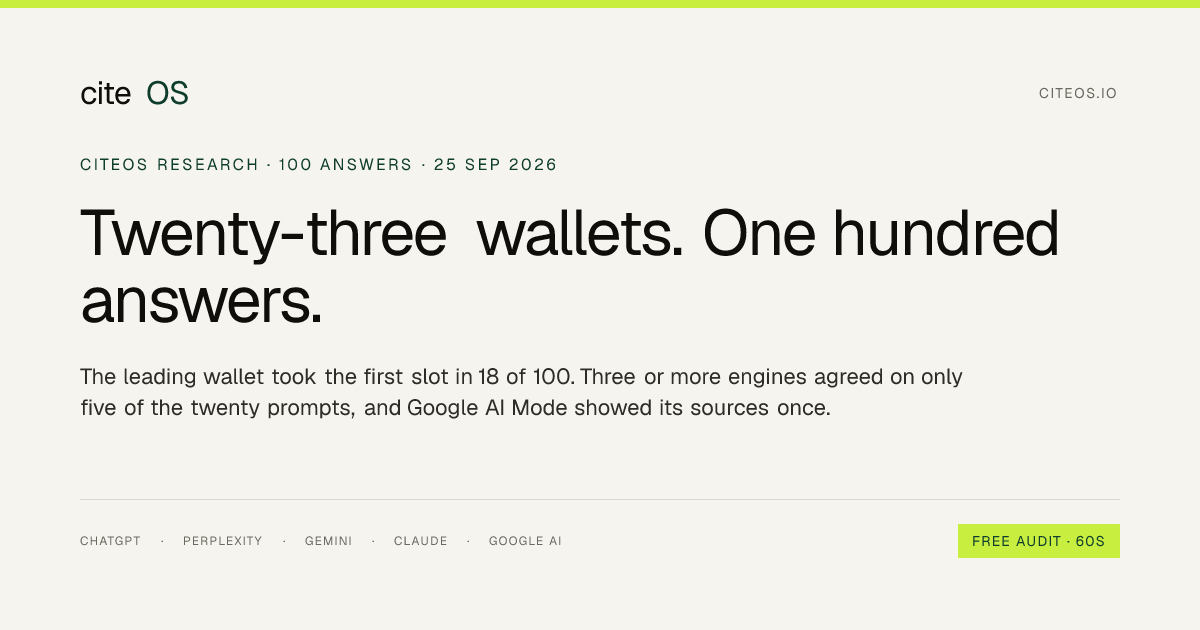
Best crypto wallet for beginners, according to AI
The full wallet audit behind the examples on this page.
Sagar SaxenaResearch
AI visibility tracking, week by week
The same prompt set on a schedule, and how to tell movement from noise.
Sagar SaxenaGuide