How to rank your crypto project on ChatGPT
ChatGPT does not rank pages. It composes an answer from sources it already trusts, then names the brands that keep appearing across them. It blends training data with live browsing, so both long-standing presence AND fresh coverage matter, which makes it slower to move than.

ChatGPT does not rank pages. It composes an answer from sources it already trusts, then names the brands that keep appearing across them. It blends training data with live browsing, so both long-standing presence AND fresh coverage matter, which makes it slower to move than Perplexity. Your homepage is a rounding error; the sources it reads are the game.
How ChatGPT decides which crypto projects to recommend
Two systems feed a ChatGPT answer, and knowing which one you are fighting changes the play:
- Training data. ChatGPT has a model of the world from before its cutoff. Brands with years of broad, consistent presence are baked in. This is why incumbents show up even when you outspend them this quarter, and it is slow to change.
- Browsing / retrieval. For current questions ChatGPT searches the live web and pulls sources, similar to Perplexity but less transparent about citations. This is the lever you can actually move in months, not years.
In our exchange study, ChatGPT put Kraken first (82 mentions), then Binance (77) and Coinbase (66). The order is not random: it tracks who is most consistently present across the trusted-source layer, and Kraken's learn hub is the second most-cited source in our entire dataset.
Does ChatGPT recommend crypto projects at all?
Yes, constantly, and more decisively than most teams realize. Across our 20 buyer prompts it named specific brands in the large majority of category answers. The uncomfortable part: it named the same small set over and over. In exchanges, three names filled every top-3 slot and no fourth brand broke in. ChatGPT does not give you a long tail to hide in. You are named or you are absent. See the full study: which crypto exchange AI engines recommend.
The moves that get you into ChatGPT answers
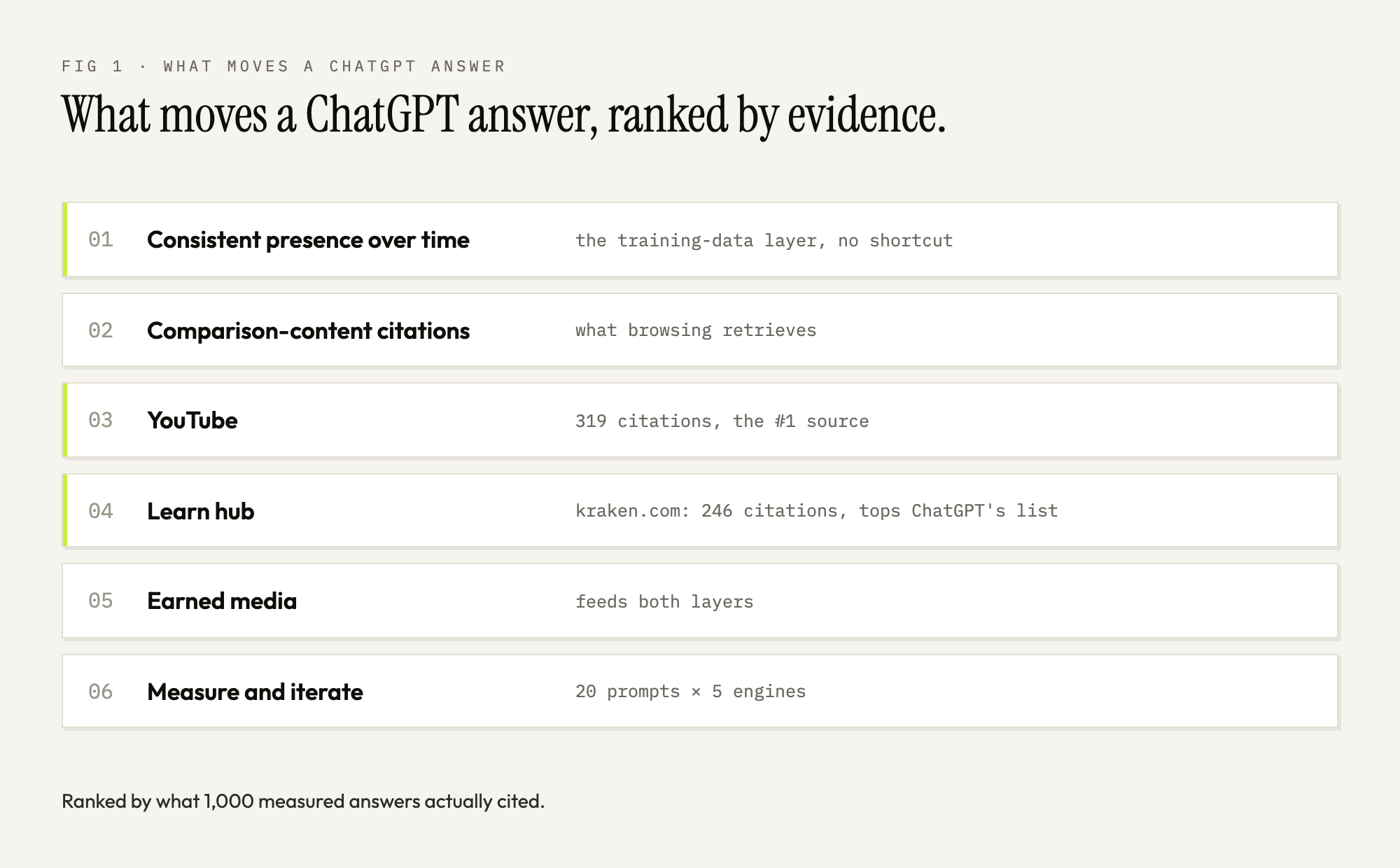
Build broad, consistent presence over time
Because training data rewards incumbency, the single highest-leverage long-term move is showing up everywhere, consistently, for a sustained period. There is no shortcut around the training-data layer; there is only starting now.
Get cited in the comparison content ChatGPT browses
When it retrieves for "best crypto X," it pulls comparison and review sites (in our data: CoinBureau, comparison roundups, CoinMarketCap). Absent from those pages, absent from the answer.
Make YouTube part of the plan
YouTube was the most-cited source in our dataset, 319 citations, more than any website. ChatGPT's browsing surfaces video reviews and explainers. If your category has none about you, you are invisible to that layer.
Build a learn hub that answers questions
The only brand domains ChatGPT cited heavily were educational hubs (kraken.com, 246 citations). It cites pages that answer buyer questions, not pages that pitch.
Earn coverage on trusted outlets
Media citations feed both the training layer over time and the browsing layer now. Pointed PR, on the outlets engines actually cite, is the compounding play.
Measure across phrasings and iterate
"Best exchange for beginners" and "safest exchange" pull different names. Find where you are absent, ship against it, re-measure. That loop is the discipline.
Ranking on ChatGPT vs Perplexity
If you only have time to optimize for one engine, know the tradeoff. Perplexity is retrieval-first and shows its citations, so fresh, current coverage moves it fastest, and it is the easiest engine for a smaller brand to break into. ChatGPT blends browsing with training data, so it favors brands with durable, long-standing presence and moves slower. Practical sequence: win Perplexity first with current coverage, then let the same consistent presence compound into ChatGPT over the following months. The full Perplexity playbook is in how to rank on Perplexity.
| Perplexity | ChatGPT | |
|---|---|---|
| How it answers | Retrieval-first, shows its citations | Blends live browsing with training data |
| What moves it | Fresh third-party coverage | Durable, long-standing presence |
| First measurable movement | Days to weeks | 6 to 8 weeks |
| Durable presence | About 6 months | Two quarters and up |
| Easier for a smaller brand | Yes | No |
| Engine weight in the citeOS score | 0.14 | 0.24 |
Practical sequence: win Perplexity first with current coverage, then let the same consistent presence compound into ChatGPT over the following months.
Want to see whether ChatGPT names you, and which sources it cites instead?
Scan my brand free →How long does it take to rank on ChatGPT?
Longer than Perplexity, honestly. Browsing-driven mentions can shift in weeks as new coverage is indexed; training-data-driven presence changes over model updates and takes months to years. Realistic expectation from client work: first measurable movement on the browsing layer in roughly six to eight weeks, durable presence a two-quarter build. Anyone promising an overnight ChatGPT ranking is selling screenshots.
How to rank a crypto project on ChatGPT
The generic advice on this page applies, but three things behave differently for a crypto project and they are the three that decide the answer.
ChatGPT applies heavier caution to financial queries. Anything touching custody, yield or trading falls into a category where the model weights trust signals harder than it does for ordinary software. Audits, proof of reserves, named team members and independent security coverage carry more weight than product copy. A project with excellent marketing and no third-party trust signals will lose to a duller competitor that has them.
The source population is not the one you would guess. Across 39,948 citation events from 72 audited crypto brands, the sources ChatGPT leans on for crypto category questions skew toward category media, aggregators, community platforms and video rather than toward the trade press a founder would name. YouTube alone accounts for 4.5 percent of all citations and appears for all 72 brands in the corpus. The full breakdown is in where AI gets crypto answers.
Your vertical decides the prompt shape. Someone choosing an exchange asks about fees, jurisdiction and withdrawal limits. Someone choosing a wallet asks about custody and recovery. Someone choosing a DeFi protocol asks about audits and TVL. Optimising for "best crypto project" optimises for nothing, because nobody asks that. Start from exchange, DeFi or wallet prompt sets depending on what you are.
Ranking a website or a business, rather than a page
The most common framing error is treating this like ranking a page. ChatGPT is not ranking your page. It is forming a view of your brand as an entity by reading many sources, then deciding whether to name it.
That reframes the work in three ways. First, one page cannot carry it: the entity view is assembled from everything the model has read about you, and 92.22 percent of the citations in our corpus land off the brand's own domain. Second, consistency across sources matters more than optimisation within one source, which is why a coherent name, description and sameAs graph outperforms another blog post. Third, the fastest wins are usually removals rather than additions: an AI crawler blocked in robots.txt, or a JavaScript-only page the model cannot read, is a total failure that no content work fixes.
Practically, for a business rather than a page: fix crawler access, make the entity consistent everywhere it appears, own the definitive page about your own category question, then expand the number of third-party pages that mention you. That last one is the lever the data actually supports.
Ranking on ChatGPT, answered.
How do I get ChatGPT to recommend my crypto project?
Get named in the sources ChatGPT trusts and browses: comparison articles, YouTube reviews, credible media, and your own question-answering content. It composes answers from those sources, then names the brands that recur across them.
Does ChatGPT recommend specific crypto exchanges or wallets?
Yes. In our July 2026 measurement it named a small, consistent set per category, e.g. Kraken, Binance and Coinbase for exchanges, filling every top-3 slot. It rarely names brands outside that consensus.
Why does ChatGPT recommend my competitor and not me?
Because your competitor appears more consistently across the sources ChatGPT trusts, often through a stronger learn hub, more comparison-content presence, or deeper media coverage. The gap is source presence, not usually product.
Is ranking on ChatGPT different from SEO?
Yes. SEO earns a ranked link a user might click; ChatGPT ranking earns a mention inside the answer itself. Different levers: earned coverage and consistent mentions beat backlinks, and being quotable beats being long.
How do I measure whether ChatGPT recommends my project?
Run the same buyer-style prompts on ChatGPT multiple times and track how often you are named and cited. A citeOS audit does this across 5 engines, 20 prompts, 100 observation points, with a free entry scan and published weights.
Go one level deeper.
Find out if ChatGPT recommends you.
Scan my brand free →