How to rank your crypto project on Perplexity (and every other AI engine)
Perplexity does not rank pages. It composes an answer from sources it already trusts, then names the brands that recur across them. It retrieves live web sources and shows its citations, which makes it the easiest engine for a smaller crypto brand to break into. Get cited in the.

Perplexity does not rank pages. It composes an answer from sources it already trusts, then names the brands that recur across them. It retrieves live web sources and shows its citations, which makes it the easiest engine for a smaller crypto brand to break into. Get cited in the sources it reads, and you get named.
What "ranking on Perplexity" actually means
Three outcomes get confused as "ranking": named (your project appears in the answer text), cited (your content is one of the sources behind the answer), and absent (neither, where most crypto projects live).
Being cited is upstream of being named: engines name the brands that keep appearing in the sources they trust. And because answers are non-deterministic, a single screenshot proves nothing. Measure across many phrasings and many runs. That is the same reason every AI visibility tool gives a different score.
How Perplexity decides who to recommend
Perplexity is a retrieval engine first: it searches the live web, picks sources it trusts, and composes an answer with citations shown. That has three practical consequences we see in audit data:
- It moves fastest. New coverage can enter answers within days, unlike engines that lean on training data.
- It reaches deepest. In our exchange study, Perplexity was the only engine of five that surfaced smaller brands, repeatedly naming a swap service no other engine mentioned. If you are not a top-3 brand, Perplexity is where you break in first.
- It shows its work. The citations under every answer are a target list. Ask your buyers' questions, read which domains it cites, and you have your placement map. The step-by-step version is the AI visibility checker.
ChatGPT blends browsing with training data; Gemini and Google AI Mode lean on Google's index. The moves below work across all of them, which matters because our study found the same shortlist but different winners on every engine. Optimizing for one engine leaves you invisible on the rest.
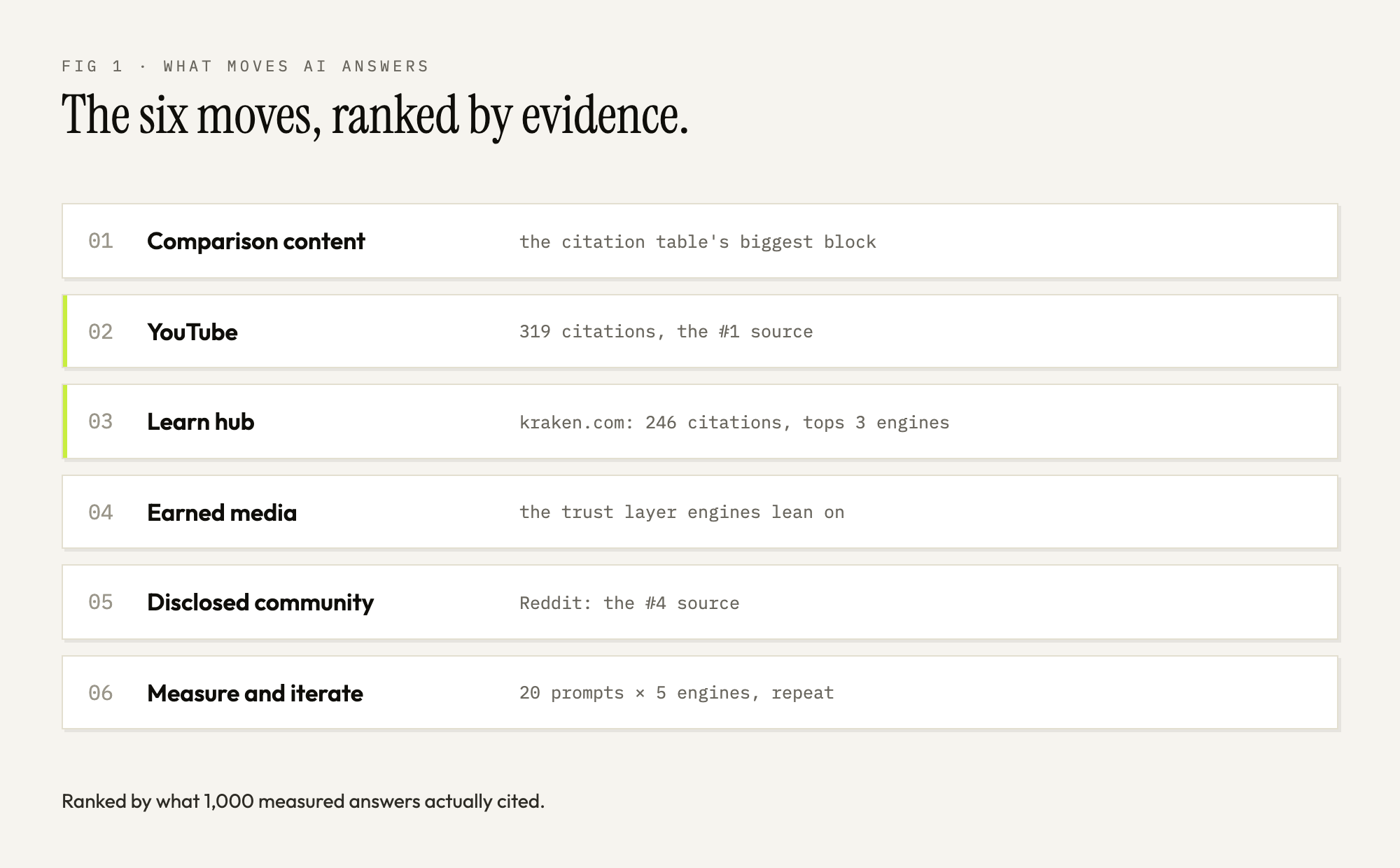
The six moves that get you into the answer
Get into the comparison content engines already cite
When we aggregated 1,000 answers, comparison and review sites (CoinBureau, BitDegree, Koinly, CoinMarketCap) filled the citation table. Engines answer "best X" questions with sources that already compare X. Absent from those pages, absent from the answer.
Treat YouTube as an AEO channel, not a social channel
YouTube was the single most-cited source in our dataset: 319 citations, more than any website. Reviews, comparisons and explainers about your project are retrievable evidence. If nobody makes them, make them.
Build a learn hub that answers buyer questions
The only brand domains that cracked our top-10 sources run large educational hubs; kraken.com earned 246 citations with answer-pages, and Kraken tops three of five engines. Landing pages pitch; engines cite pages that answer.
Earn coverage on the outlets engines trust
Media citations (Forbes, crypto-native outlets) carry the trust layer. This is PR, but pointed: place where engines cite, not where impressions look good. We score 500+ crypto outlets on exactly this.
Show up in communities, disclosed
Reddit was fourth in our source table. Answers to real buyer questions, posted under your real name and title, become retrievable. Astroturf gets dissected in public, and engines read the dissection too.
Measure across phrasings, then iterate
"Best exchange for beginners" and "best no-KYC exchange" produce different names. Audit the phrasings your buyers use, find where you are absent, ship against the gap, re-measure on a cadence. That loop is the whole discipline.
What doesn't work
- Keyword stuffing your own site. Your domain is a minority of the citation table; the majority is territory you have to earn.
- llms.txt alone. Worth shipping (it costs nothing), but adoption data shows crawlers rarely fetch it. It is a courtesy signal, not a strategy.
- A single flattering screenshot. Non-deterministic answers mean cherry-picked proof. If a vendor shows you one screenshot, ask for the prompt list and sample counts.
| Perplexity | ChatGPT | |
|---|---|---|
| How it answers | Retrieval-first, shows its citations | Blends live browsing with training data |
| What moves it | Fresh third-party coverage | Durable, long-standing presence |
| First measurable movement | Days to weeks | 6 to 8 weeks |
| Durable presence | About 6 months | Two quarters and up |
| Easier for a smaller brand | Yes | No |
| Engine weight in the citeOS score | 0.14 | 0.24 |
Practical sequence: win Perplexity first with current coverage, then let the same consistent presence compound into ChatGPT over the following months.
Want to see which sources Perplexity cites for your category, and where you're absent?
Scan my brand free →How long does it take?
Honest ranges from client work: Perplexity reflects new third-party coverage in days to weeks; ChatGPT and Gemini move slower where training data dominates. First measurable movement in about six weeks; a durable presence is a six-month build. Anyone promising overnight AI rankings is selling screenshots.
The engine-by-engine differences matter here. For the ChatGPT-specific version of this playbook, see how to rank your crypto project on ChatGPT, and for the Google-grounded engine see how to rank on Gemini.
How to rank a crypto project in Perplexity
Perplexity behaves differently from ChatGPT in one way that matters more than any other: it shows its sources inline, and it leans harder on live retrieval than on model memory. That makes it the most diagnosable engine in the set, and the fastest to move.
Because retrieval dominates, freshness and crawlability carry unusual weight. A page published this week can be cited this week, which is not reliably true elsewhere. It also means an access failure is more punishing: if PerplexityBot or Perplexity-User cannot fetch you, you are simply not in the candidate set, regardless of how strong the content is.
For a crypto project specifically, Perplexity draws heavily on community and aggregator sources when answering category questions, and applies visible caution to financial claims. Coverage that a model can attribute to a named third party outperforms assertions on your own site. The source populations are documented in where AI gets crypto answers, and the vertical prompt shapes in exchange, DeFi and wallet guides.
One practical advantage: because Perplexity lists its sources, you can read the answer to your own category prompt and get a ranked list of the domains deciding it. That list is a coverage target list. Most teams never look at it.
Ranking on Perplexity, answered.
How do I get my crypto project recommended by Perplexity?
Get named in the sources Perplexity already cites for your category: comparison articles, YouTube reviews, community threads, and your own question-answering content. Ask your buyers' questions on Perplexity, read the citations, and target those exact surfaces.
Can a small crypto project rank on AI engines?
On Perplexity, yes, fastest of all engines. In our 1,000-observation exchange study it was the only engine that surfaced brands outside the consensus top tier, because it retrieves live niche sources rather than leaning on training data.
How is ranking on ChatGPT different from Perplexity?
ChatGPT mixes training data with browsing, so it favors brands with long-standing presence; Perplexity favors current, retrievable coverage. Same playbook, different speed: expect Perplexity to move first and ChatGPT to follow. See how to rank on ChatGPT.
How do I measure my AI ranking?
Run the same buyer-style prompts across all five engines, multiple times, and track how often you are named and cited. That is exactly what a citeOS audit does: 20 prompts across 5 engines, 100 observation points, free entry scan, weights published.
Go one level deeper.
Find out if Perplexity recommends you.
Scan my brand free →