LLM SEO for crypto brands in 2026: what changes when the reader is a model
LLM SEO is not a new trick for Google. It is the same marketing job aimed at a different reader: a language model that answers your buyer by reading other people’s pages about you. This is the marketing team’s version, with the data that says where that reader actually looks.
Data note, updated 30 Oct 2026. Counts in this article track the live citeOS corpus: 88,975 citation events from 81 audited brands across 7,432 source domains, June to October 2026. Percentages and per-brand findings come from our April to August 2026 citation study (39,948 citations) and still hold on the live data within a point: 91.47% of live citations land off the brand's own domain, against 92.22% in the study.

LLM SEO is the work of getting a large language model to name your brand when a buyer asks it a question, and to cite pages that back that up. For a crypto marketing team the change is one sentence: the reader is now a model, and it mostly reads pages you do not own. In our citation study, 92.22% of citations landed off the brand’s own domain.
Search “llm seo” and half of what comes back is written for engineers: embeddings, retrieval pipelines, fine-tuning. That is a real discipline and it is not this one. This page is for the person who owns a crypto brand’s narrative and has noticed that buyers now ask ChatGPT, Perplexity, Gemini, Claude and Google AI Mode which exchange, wallet or card to use, and get a short list of names back.
The question for that person is not how the model works. It is what the model has read about the brand, where it read it, and what would change the answer. Those are marketing questions, and they have measurable answers.
What does LLM SEO mean for a crypto brand?
For a crypto brand, LLM SEO means being one of the names a model gives when a buyer asks a category question, such as “best exchange for beginners” or “safest self-custody wallet”. The brand-name question (“is Acme safe?”) matters less, because the brand nearly always appears in answers about itself.
The vocabulary is a mess. LLM SEO, LLM search optimization, AI SEO, generative engine optimization and answer engine optimization describe the same practice from different starting points. Pick the word your audience uses and do the work once. The work does not change with the label.
Two outcomes are worth separating from the start. Named means the model put your brand in the sentence the buyer reads. Cited means it linked a page as a source underneath. A buyer acts on the names, so being named is the commercial result. The citations tell you which pages produced it, which makes them the to-do list.
What changes when the reader is a model, not a person?
Three things change: the model reads many pages at once, it trusts consistency over persuasion, and it leans on what other sites say about you far more than on what you say about yourself. Copy written to convert a human visitor does very little here.
- It reads breadth, not one page. A person lands on your homepage and decides. A model assembles an answer from several sources and names the brands that keep turning up across them. One brilliant landing page is one vote.
- It rewards consistency. If your founding year, fee, licence or supported chains differ between your site, CoinGecko, a review and a Reddit thread, the model has less reason to state any of them confidently. Fix the facts before you write anything new.
- It weighs other people’s pages. In our study 7.78% of citations pointed at the audited brand’s own domain and 92.22% pointed elsewhere. Your site still matters as the source of record, but most of the answer is settled off it.
- It quotes specifics. Named entities, numbers with dates and plain definitions are easy for a model to lift. Adjectives are not. “Lowest fees” is a claim; “0.1% maker fee on spot, checked 1 November” is a fact a model can repeat.
How is LLM search optimization different from Google SEO in 2026?
Google SEO wins a ranked link to one page; LLM search optimization wins a place in a generated answer that draws on many pages. The overlap is real, because several engines retrieve from a web index, but the unit of success and the main lever are different.
| Question | Google SEO | LLM search optimization |
|---|---|---|
| What you win | A position for one URL | A mention, and sometimes a citation, inside the answer |
| Main lever | Your page, plus links pointing at it | How many credible pages mention you, and whether they agree |
| Who controls the outcome | Mostly you, on your own domain | Mostly other publishers: 92.22% of citations in our study were off-domain |
| How it is measured | Rank and clicks per keyword | Named and cited rates on a fixed prompt set, across engines |
| How stable it is | Fairly stable week to week | Non-deterministic: the same prompt can return a different list |
None of this makes Google SEO pointless. Gemini and Google AI Mode lean on Google’s index, so a page that ranks for the buying question is a page those engines are likely to read. The fuller comparison is in AEO vs SEO for crypto and the wider picture in AI SEO: what it is and what works.
What does the data say drives LLM citations?
Coverage. Across 88,975 citation events from 81 audited crypto brands, citation volume tracks the number of pages that mention a brand at approximately 1.48 citations per page, with r = 0.80. More credible pages about you means more citations, and the ratio barely moves between categories.
The coefficient of variation on that ratio is 9.5% across payment processors, exchanges, DeFi, DePIN and gambling brands. The stability is the useful part. A correlation this tight between pages and citations is close to what you would expect, but a ratio that holds across very different categories gives a marketing team something to plan against: the lever is the count of credible pages that discuss you, not a clever format on any one of them.
One more finding points the same way. A brand that is the subject of a page averaged 6.22 citations in our study, against 3.78 for a brand ranked inside someone else’s list. So coverage is not just volume of mentions: pages that are actually about you do more work than a line in a roundup.
What the data does not support is the format folklore. We tested FAQ blocks, ratings, verdicts and tables on the most-cited pages and found no lift we could distinguish from zero. Ship those for the reader. Do not expect them to move a model.
Where do LLMs read about crypto brands?
Mostly on a long tail of third-party sites, not on the brand’s own domain and not on the famous outlets. In our study 79.09% of citations went to long-tail domains outside every named category, 7.78% to the brand itself, 4.49% to YouTube and 2.19% to Reddit.
The press split is the one that surprises crypto marketers. Tier-1 crypto press (CoinDesk, Cointelegraph, The Block, Decrypt) carried 143 citation events, 0.36% of the study. A basket of 21 mid-tier outlets carried 907, so they were cited 6.34 times more often. If your PR budget only buys logos for the homepage, it is buying the smaller lever. The outlet-level view is in crypto PR distribution.
What should a crypto marketing team do first for LLM SEO?
Fix your facts, find the pages the engines already cite for your category, and get onto them, in that order. Publishing more on your own site comes after, because it is the smallest of the three levers.
- Make the facts agree everywhere. Fees, licences, supported chains, founding year and team names should match across your site, CoinGecko or CoinMarketCap, your X bio, LinkedIn and any directory listing. Inconsistency gives a model a reason to hedge.
- Pick 20 buyer questions and run them. Category, comparison and how-to questions, not your brand name. Record who is named and which pages are cited. That cited list is your outreach list.
- Earn a place on the pages already cited. Review sites, comparison pages, mid-tier crypto outlets, YouTube explainers and relevant Reddit threads. Disclose any relationship. Paid placement that hides the relationship is a trust risk you do not need.
- Be the subject, not a line item. A page about your brand outperformed a mention in someone else’s list in our study. Pitch features, interviews and reviews, not only inclusion in roundups.
- Then publish one clear page per buying question on your own site. Answer first, specifics with dates, server-rendered so crawlers see it. It becomes the source of record that third-party pages can point to.
Want the cited list for your category without running the prompts by hand? The free scan shows which pages 5 engines read instead of you.
Scan my brand free →How do you measure LLM SEO?
Run the same fixed set of buyer prompts across several engines on a schedule, and track how often you are named and how often you are cited. One run is a sample; the trend across runs is the reading.
citeOS runs 20 buyer-style prompts across 5 engines (ChatGPT, Perplexity, Gemini, Claude and Google AI Mode) for 100 observation points per audit, and publishes every weight on the methodology page. You can do a smaller version by hand with the AI visibility checker method, or set up a weekly routine with AI visibility tracking. Whatever you use, keep the prompt set fixed. Changing the questions mid-series makes the trend meaningless.
Expect noise. Models are non-deterministic, so the same prompt can return a different list an hour later. Movement on one prompt in one week is not a result. Movement across most prompts for several weeks is.
Is LLM SEO the same as training or fine-tuning a model?
No. A brand cannot fine-tune ChatGPT or Gemini, and LLM SEO for marketing never touches model weights. It works on the public material models read when they answer, and on what their training data already contains about you.
The engineering meaning of the phrase (retrieval pipelines, embeddings, tuning your own model for your own product) is a separate field with its own playbook. If your team is building a chatbot for your own app, that is the field you want. If your team wants ChatGPT to name you when a buyer asks for the best wallet, it is this one.
How was this checked?
| What | How |
|---|---|
| Corpus counts | 88,975 citation events across 81 audited crypto brands, 28,011 pages and 7,432 source domains, June to October 2026, from the live citeOS corpus. Every audit is 20 buyer prompts across 5 engines. |
| Percentages and findings | From our citation study, published in full at the AI citation study. They still hold on the live data within a point, as the data note at the top says. |
| Coverage law | Per-brand citations against the number of pages mentioning the brand: about 1.48 citations per page, r = 0.80, coefficient of variation 9.5% across categories. |
| Formats | FAQ, rating, verdict and table effects were tested on the hand-read set of most-cited pages and none was distinguishable from zero. No multiplier is claimed here. |
| Weights | All scoring weights are on the methodology page. |
| Conflict of interest | citeOS is our product, operated by Emergence Media, who publish this page. Other crypto AEO tools exist; see crypto AEO tools compared. |
What else do people ask about LLM SEO?
What is LLM SEO?
LLM SEO is the practice of getting large language models such as ChatGPT, Perplexity, Gemini, Claude and Google AI Mode to name your brand in their answers to buyer questions, and to cite pages that support it. For marketing teams it overlaps almost entirely with AEO, GEO and AI SEO. The labels differ; the work does not.
What is LLM search optimization?
The same thing under a longer name: optimizing for the search features inside language models, where the answer is generated from several sources instead of being a list of links. The lever is coverage on credible third-party pages, because in our citation study 92.22% of citations landed off the brand’s own domain.
Is LLM SEO different from regular SEO?
Yes, in what you win and who controls it. SEO wins a ranked position for one of your pages. LLM SEO wins a mention inside an answer built from many pages, most of which you do not own. They overlap where an engine retrieves from a search index, which is why a page that ranks for the buying question still helps.
What actually drives LLM citations for a crypto brand?
Coverage. Across 88,975 citation events from 81 audited crypto brands, citation volume tracks the number of pages that mention a brand at approximately 1.48 citations per page, r = 0.80, with a coefficient of variation of 9.5% across categories. Pages that are about the brand do more work than mentions in someone else’s list.
Do FAQ sections or tables help a page get cited by an LLM?
Not measurably. We tested FAQ blocks, ratings, verdicts and tables on the most-cited pages in our study and could not distinguish any lift from zero. Use them because they help a human reader find the answer, not as a ranking trick.
How long does LLM SEO take to show results?
Retrieval-led engines such as Perplexity can move within weeks once new third-party pages are indexed. Answers that lean on training data move more slowly, because they reflect what the model learned before its cut-off. Measure on a fixed prompt set over several weeks before you call a result.
Disclosure. Published by Emergence Media, which operates citeOS. Contact: Sagar Saxena on X. citeOS is our product and is mentioned on this page. AI answers are non-deterministic, so any single answer you see may differ from the patterns described here. Nothing here is investment advice.
Related articles
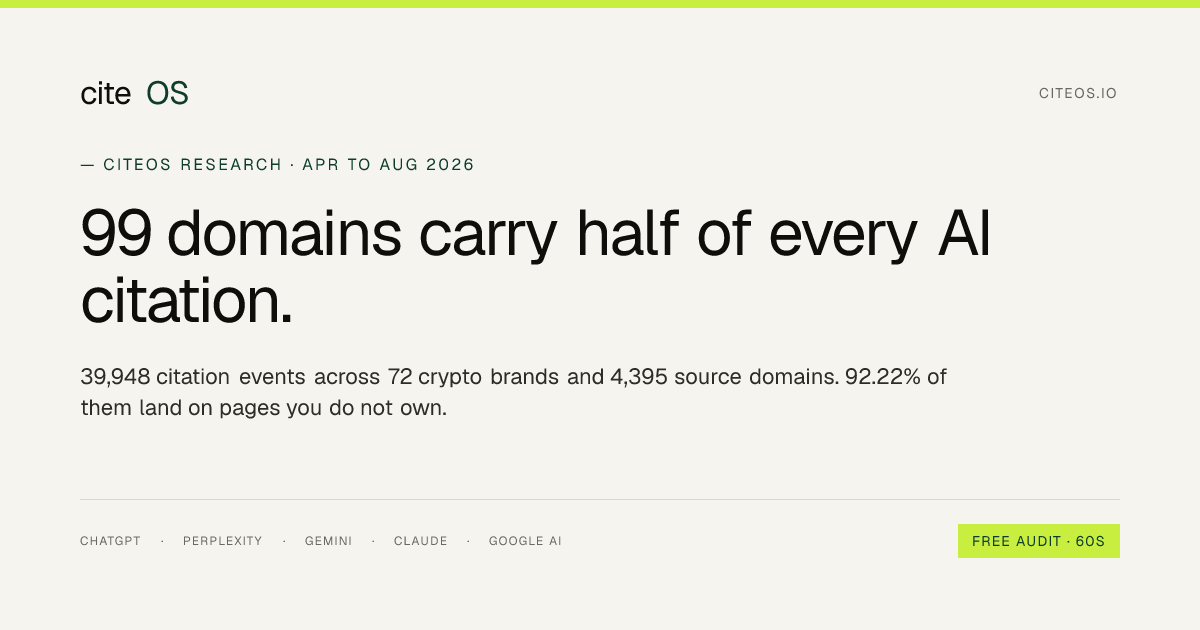
What gets crypto brands cited by AI
The study behind the figures on this page, with the full method.
Sagar SaxenaResearch
Generative engine optimization (GEO)
The same practice under its academic name, with the levers in order.
Sagar SaxenaGuide
ChatGPT ads: pay for the answer, or earn it?
What a paid slot next to the answer does, and what it leaves untouched.
Sagar SaxenaGuide